

How Do DUI Attorneys in Prince George’s County Typically Handle Criminal Defense Cases?
“`htmlHow Do DUI Attorneys in Prince George’s County Typically Handle Criminal Defense Cases?
DUI attorneys in Prince George’s County usually defend criminal cases by attacking the prosecution in stages: the traffic stop, detention, field sobriety testing, arrest decision, breath or blood evidence, MVA license consequences, negotiations, and trial strategy.
TL;DR: How Prince George’s County DUI Attorneys Usually Approach DUI Defense
A Prince George’s County DUI defense lawyer typically starts by separating the case into two tracks: the criminal court case and the MVA license case. Then the attorney reviews the stop, detention, field sobriety tests, officer observations, body-camera footage, breath test or blood evidence, and any mitigation issues that could affect the client’s license, record, employment, immigration status, or future.
- First: review the legality of the traffic stop and detention.
- Second: challenge field sobriety tests, police conclusions, and chemical evidence.
- Third: protect the client’s driving privileges through the MVA process.
- Fourth: negotiate from leverage or prepare the case for trial.
Prince George’s County DUI Defense Is Both Local and Technical
A DUI case in Prince George’s County is not just a traffic ticket. It is usually a criminal defense case, a serious traffic case, and an administrative license case all at the same time. That means a DUI attorney has to think about the District Court case, the Maryland Motor Vehicle Administration consequences, and the real-life effect on the client.
The criminal case may involve charges such as DUI, DWI, negligent driving, reckless driving, failure to obey traffic control devices, speeding, or other must-appear traffic citations. The administrative case may involve a possible license suspension, ignition interlock, refusal allegation, or MVA hearing deadline.
Step One: A DUI Attorney Reviews the Traffic Stop
The first major issue in a Prince George’s County DUI case is whether the officer had a lawful reason to stop the vehicle. DUI stops may begin with alleged speeding, swerving, failing to maintain lane, driving without headlights, a crash, a welfare check, or a report from another driver.
But an officer’s conclusion is not the same thing as proof. A defense attorney should compare the police report against the video, the road conditions, the officer’s actual observations, and the legal standard for reasonable articulable suspicion.
- Did the officer actually observe a traffic violation?
- Was the alleged violation captured on video?
- Was the stop based on a reliable report or an unsupported tip?
- Did the officer exaggerate normal driving behavior?
- Was the stop unlawfully extended into a DUI investigation?
Step Two: The Attorney Challenges the Detention
Even if the initial stop was lawful, the officer still needs a legally sufficient basis to expand the encounter into a DUI investigation. A driver may be stopped for a minor traffic issue. That does not automatically justify field sobriety testing, prolonged questioning, or arrest.
Police reports often rely on phrases like “odor of alcohol,” “red glassy eyes,” “slurred speech,” or “admission to drinking.” A good DUI attorney does not accept those phrases at face value. Red eyes can come from fatigue, allergies, smoke, crying, contact lenses, or medical issues. Odor of alcohol does not prove intoxication. Nervousness during a police stop is ordinary.
Step Three: The Attorney Attacks Field Sobriety Testing
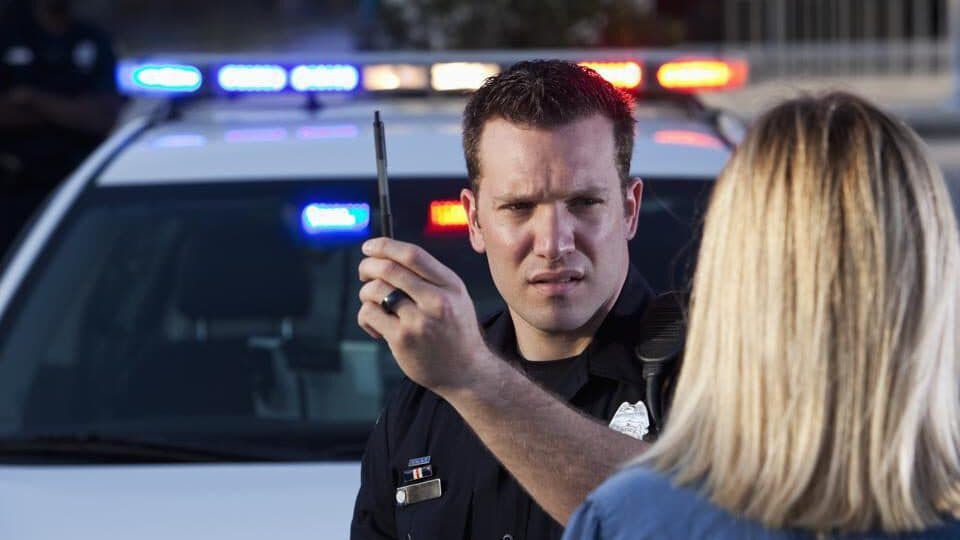
Field sobriety tests are often central to DUI prosecutions in Prince George’s County. These tests may include Horizontal Gaze Nystagmus, Walk-and-Turn, and One-Leg Stand. They are supposed to be administered according to standardized procedures and interpreted carefully.
A DUI lawyer will usually examine whether the officer properly explained the instructions, demonstrated the test, chose a safe and level surface, asked about medical limitations, accounted for footwear, and accurately counted alleged clues.
- Was the surface level, dry, and safe?
- Was there traffic, flashing lights, or poor lighting?
- Did the officer ask about injuries or medical conditions?
- Were the instructions complete and understandable?
- Did the video actually support the officer’s report?
Step Four: The Attorney Reviews Breath or Blood Evidence
If the case involves a breath test, the attorney should review the breath result, testing procedure, observation period, operator certification, machine maintenance, and whether the test was performed correctly. If the case involves blood evidence, the attorney should evaluate collection method, chain of custody, laboratory procedures, timing, and toxicology assumptions.
Chemical evidence can look powerful, but it is not immune from challenge. A number does not automatically prove impairment at the time of driving. The defense may question whether the test was reliable, whether procedures were followed, whether the result was scientifically meaningful, and whether the State can properly connect the result to the alleged driving.
Step Five: The Attorney Handles the MVA License Case
DUI defense in Prince George’s County often requires immediate attention to the Maryland MVA process. If the driver refused a test or submitted a test result that triggers administrative sanctions, the client may face license consequences before the criminal case is resolved.
The attorney may review the DR-15 advice form, the test result, the refusal allegation, the hearing deadline, ignition interlock options, and whether an administrative hearing should be requested.
Step Six: The Attorney Evaluates the Client’s Real-Life Risk
DUI defense is not just about the legal elements. A DUI can affect employment, immigration status, security clearance, professional licensing, commercial driving privileges, insurance, family responsibilities, and future sentencing exposure.
A serious defense strategy accounts for the client’s life. A first-time DUI for a professional driver, federal employee, nurse, teacher, noncitizen, or security-clearance holder may require a different strategy than a case involving a person with no special collateral consequences.
Step Seven: The Attorney Negotiates From Leverage
Many DUI cases are resolved without trial. But the best negotiated outcomes usually come from preparation. A DUI attorney may negotiate for dismissal, reduction, probation before judgment, reduced companion citations, no jail, limited probation, treatment-based mitigation, or a resolution that protects the client’s future.
Strong negotiation is not begging. Strong negotiation means identifying the weaknesses in the State’s case and using those weaknesses to pursue a better result.
Step Eight: The Attorney Prepares for Trial
Trial preparation in a Prince George’s County DUI case may involve reviewing body-camera footage, comparing the officer’s report to video evidence, preparing cross-examination, challenging field sobriety tests, attacking the arrest decision, and questioning chemical evidence.
The defense theory must match the facts. Some cases are about an illegal stop. Some are about weak impairment evidence. Some are about whether the State can prove driving. Some are about unreliable testing. Some are about reasonable doubt from start to finish.
Common DUI Defense Strategies in Prince George’s County
1. Attack the Stop
If the officer lacked reasonable suspicion or probable cause for the stop, the defense may seek suppression of evidence obtained after the stop.
2. Attack the Detention
Even if the traffic stop was lawful, the officer may not have had enough evidence to expand the stop into a DUI investigation.
3. Attack the Arrest
Probable cause for arrest must be supported by facts. Weak field sobriety testing, vague observations, and inconsistent reports can undermine the arrest decision.
4. Attack the Field Sobriety Tests
Field sobriety testing can be challenged based on instructions, conditions, scoring, medical limitations, footwear, lighting, surface conditions, and video evidence.
5. Attack the Chemical Test
Breath and blood evidence can raise issues involving timing, reliability, calibration, maintenance, procedure, chain of custody, and expert interpretation.
6. Build Mitigation
Alcohol education, treatment, evaluations, community service, employment records, family responsibilities, and a clean prior record can help support a better negotiated or sentencing outcome.
What Makes Prince George’s County DUI Cases Different?
Prince George’s County has a mix of local roads, commuter corridors, highways, residential areas, nightlife zones, shopping centers, and heavily traveled routes near Washington, D.C. DUI arrests may involve county police, local municipal departments, Maryland State Police, Park Police, or other agencies.
A county-specific defense should consider the arresting agency, court location, officer experience, availability of body-camera footage, whether there was a crash, whether the case involves alcohol or drugs, and whether the client has separate license or collateral consequences.
Should You Fight a DUI in Prince George’s County?
In many cases, yes. Fighting a DUI does not always mean a full trial. It means forcing the State to prove the case, reviewing the evidence, preserving defenses, protecting the license, and negotiating from strength.
Even when a case resolves by agreement, the outcome may be substantially better because the defense attorney investigated the case, identified weaknesses, and prepared for trial.
Bottom Line
DUI attorneys in Prince George’s County typically handle criminal defense cases by investigating every stage of the prosecution: the stop, detention, field sobriety testing, arrest, breath or blood evidence, MVA consequences, mitigation, negotiation, and trial strategy.
A strong DUI defense is not just about showing up in court. It is about finding the pressure points in the State’s case and using them to protect the client’s license, record, freedom, employment, and future.
FAQ: Prince George’s County DUI Criminal Defense
Do DUI attorneys in Prince George’s County usually go to trial?
Sometimes. Many DUI cases resolve through negotiation, but a serious DUI attorney should prepare as if trial is possible. Trial readiness often improves negotiation leverage.
Can a DUI be dismissed in Prince George’s County?
Yes. Dismissals may happen because of evidentiary problems, witness issues, unlawful stops, weak probable cause, unreliable testing, missing evidence, or successful motions.
Is a DUI case only about the breath test?
No. A DUI case may involve the stop, detention, field sobriety tests, officer observations, chemical testing, timing, driving evidence, body-camera footage, and constitutional issues.
What is the difference between DUI and DWI in Maryland?
Maryland generally treats DUI as the more serious impaired-driving offense and DWI as a lesser impaired-driving offense. The exact charge and proof issues depend on the facts and evidence.
Can a lawyer help with the MVA hearing too?
Yes. A DUI attorney can help evaluate whether to request an MVA hearing, whether ignition interlock is appropriate, and how to protect driving privileges after a DUI arrest.
What should I bring to a DUI consultation?
Bring the citations, DR-15 form, temporary license paperwork, court notices, MVA paperwork, police reports if available, witness information, and any facts about medical issues, injuries, medications, or employment driving needs.
What is PBJ in a Maryland DUI case?
PBJ stands for probation before judgment. It can be an important outcome in some Maryland DUI cases because it may avoid a final conviction, although it may still involve probation, conditions, and future consequences.