

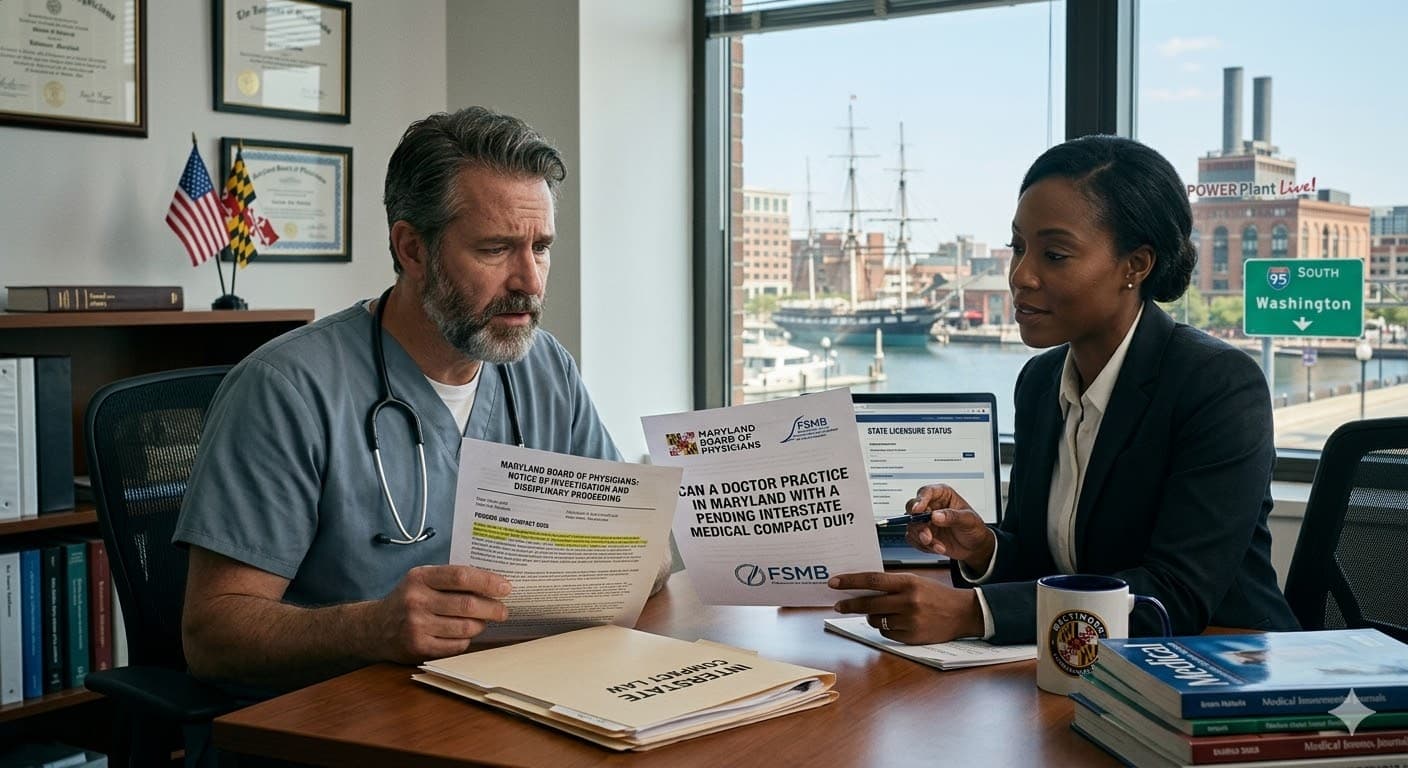

Can a doctor practice in Maryland with a pending interstate medical compact DUI? It depends. But the safest possible way to fight this is to hire the lawyer that fights for an absolute total dismissal or acquital for every case. Every time. You get two bites at the apple in Maryland, lawyers that do not fight the case in the District Court are lazy and irresponsible. You can always get the PBJ later in Circuit Court. There’s no down side to fighting. Ever.
Can a doctor practice in Maryland with a pending interstate medical compact DUI?
A doctor asking this question is usually not just worried about court. They are worried about hospital privileges, credentialing, compact eligibility, malpractice optics, peer review, and whether a single bad event is about to metastasize into a board problem. The key issue is the interstate medical compact DUI problem and what it does to a physician’s ability to keep working while the case is still pending.
For many physicians, the practical answer is this: a pending DUI does not automatically mean instant professional death, but an interstate medical compact DUI can complicate compact eligibility, slow or derail Maryland licensing pathways, and create a second problem with the Board if the matter is mishandled, hidden, minimized, or allowed to suggest impairment or dishonesty.
Can a doctor practice in Maryland with a pending interstate medical compact DUI?
Can a doctor practice in Maryland with a pending interstate medical compact DUI? Sometimes yes, sometimes no, and the distinction usually turns on posture. If the physician already holds an active, unrestricted Maryland license and the Board has not imposed an interim restriction, the doctor may often keep practicing while the matter is pending. But if the physician is trying to obtain Maryland licensure through reciprocity or through an expedited compact route, a pending interstate medical compact DUI can become a serious obstacle fast.
The reason is simple. The Interstate Medical Licensure Compact is an optional expedited path, and its official physician information says applicants must hold a full unrestricted license, have no disciplinary-action history toward their medical license, have no criminal history, and have no controlled-substance discipline. Maryland’s own reciprocity rule separately requires an active unrestricted out-of-state license, good standing in every jurisdiction, and a state and national criminal history check. This is why a compact-related DUI problem can hit licensing even before it hits discipline.
Interstate medical compact DUI problems are often licensing problems before they become discipline problems
Many physicians think in the wrong order. They assume the only real risk is whether the Maryland Board of Physicians will formally discipline them. But with an interstate medical compact DUI, the first problem may be eligibility, application delay, criminal-history review, or loss of the fast-track route. The Board may also request additional documentation it thinks is needed to evaluate the application.
That means a doctor can face real professional disruption before any formal order ever appears. Hospital start dates, employer onboarding, payer enrollment, locums timelines, and contract opportunities can all be threatened by a licensing bottleneck caused by the pending DUI.
Why an interstate medical compact DUI is different from an ordinary doctor DUI problem
An ordinary physician DUI problem is already serious. Add the compact, and the problem becomes narrower and harsher. The official IMLC physician page says applicants must not have any criminal history and must not have any history of disciplinary actions toward their medical license. That language is blunt. A physician trying to move quickly through the compact with a pending or recently developed criminal issue is walking into a system designed to reject messy files, not rehabilitate them.
That is why this page treats an interstate medical compact DUI as a career-survival issue, not just a criminal-defense issue.
Interstate medical compact DUI and Maryland physician DUI licensure are not identical questions
A doctor may be asking one of two different things without realizing it. The first question is whether the doctor can keep practicing in Maryland right now. The second is whether the doctor can obtain or expand Maryland licensure through the compact or reciprocity. Those are not the same question. An interstate medical compact DUI can make the second question much uglier than the first.
If the physician already has a clean, active Maryland license and there is no immediate Board restriction, the practical reality may be more survivable in the short term. If the physician needs Maryland through a compact-style pathway, the criminal-history and good-standing issues may become the real emergency.
Interstate medical compact DUI and the criminal-history bottleneck
Maryland’s application materials say physicians seeking initial licensure must complete a criminal history background check, and Maryland’s reciprocity rule says the Board may not issue the license if the criminal history records information has not been received. That does not mean every DUI is an automatic permanent bar. It does mean criminal-history information is built directly into the gatekeeping process.
So when a physician asks whether a pending interstate medical compact DUI kills the Maryland plan, the sober answer is that the DUI can trigger review, delay, questions, documentation demands, and a harder path than the physician expected.
Interstate medical compact DUI and hospital credentialing risk
Even when a physician technically remains able to practice, a pending interstate medical compact DUI can create parallel problems with hospital systems, medical groups, insurers, locums companies, and credentialing committees. A physician can survive the courthouse and still get bloodied by employment paperwork, onboarding disclosures, or peer-review concern about judgment and patient safety optics.
That is why the strategy cannot stop at “beat the charge if possible.” The strategy also has to reduce what the event looks like on paper while preserving truthful, consistent disclosure where required.
Can a doctor practice in Maryland with a pending interstate medical compact DUI if there is no Board order yet?
Often that question turns on whether there is already a Maryland license in hand and whether anything has happened to it. The Maryland Board of Physicians is the agency with authority to license physicians and take Board actions. FSMB’s guide explains that boards investigate complaints, may resolve matters by settlement or hearing, and can impose anything from reprimands to restrictions, suspension, or revocation if violations are proven. So until the Board actually acts, a physician with an active unrestricted license is not necessarily out of practice immediately.
But that is not a comfort blanket. A pending interstate medical compact DUI can still be an existential licensing and credentialing problem even before there is a formal disciplinary order.
Interstate medical compact DUI cases are often won or lost in the disclosures
Doctors sometimes assume the criminal case is the whole war. It is not. Disclosure language to the Board, to hospitals, to credentialing bodies, to locums companies, and to carriers can either keep the matter contained or make it look evasive, defensive, or impairment-adjacent. That is why an interstate medical compact DUI case has to be coordinated from the beginning.
The wrong answer on an application, an incomplete explanation, or a sloppy timeline can create a credibility problem that outlives the DUI itself.
Interstate medical compact DUI and “good standing” problems
Maryland’s reciprocity regulation requires the applicant to be in good standing under the laws of every jurisdiction where the individual is licensed. That phrase matters. Physicians often focus only on whether they have technically been disciplined. But the real-world problem is broader: investigations, restrictions, application denials, disclosure problems, or unresolved criminal matters can all make the file feel unstable.
That is one reason an interstate medical compact DUI should be treated as a full professional-survival issue instead of a narrow criminal case.
Interstate medical compact DUI and physician criminal history Maryland license review
The compact’s own public physician guidance says “no criminal history.” Maryland’s own application materials require criminal-history processing. Put those together and the message is obvious: a physician trying to move a new license file through Maryland with an unresolved or fresh DUI should expect scrutiny.
This is exactly why many doctors need a defense plan that addresses not just the DUI facts, but the timeline, disclosure posture, background-check fallout, and credentialing consequences.
What a smart response to an interstate medical compact DUI looks like
- figure out immediately whether the doctor already holds an active unrestricted Maryland license or still needs Maryland through compact or reciprocity;
- separate criminal-defense goals from licensing-disclosure goals while keeping them consistent;
- avoid casual written explanations that create a judgment or credibility problem;
- screen for any facts suggesting impairment, patient-safety issues, or recurring alcohol use;
- protect hospital and employment opportunities while the criminal case is still alive;
- work toward the cleanest defensible outcome instead of sleepwalking into a professionally toxic paper trail.
Interstate medical compact DUI does not mean every doctor is finished
An interstate medical compact DUI is serious. It is not automatically the end of a medical career. But it is exactly the kind of issue that can cost a doctor far more than a fine if handled lazily. The physician may still be able to practice, may still preserve the license, and may still contain the damage. The key is understanding which part of the system is the real threat: current Maryland practice, compact eligibility, reciprocity, credentialing, or all of the above.
Can a doctor practice in Maryland with a pending interstate medical compact DUI? The practical answer.
Can a doctor practice in Maryland with a pending interstate medical compact DUI? Sometimes yes, especially if the doctor already holds an active unrestricted Maryland license and no interim Board action exists. But if the doctor is relying on the compact or reciprocity to get into Maryland or expand practice, the DUI can absolutely become a licensing-roadblock problem. The practical response is to protect the criminal case, protect the disclosure posture, and protect the professional file all at once.
Related pages for professionals with too much to lose
FAQ: Interstate medical compact DUI
Can a doctor practice in Maryland with a pending interstate medical compact DUI?
Sometimes yes, especially if the doctor already has an active unrestricted Maryland license and no interim Board restriction. But the pending DUI can still become a major compact, reciprocity, or credentialing problem.
Does an interstate medical compact DUI automatically make a physician ineligible?
The compact’s public eligibility language is strict and includes no criminal history and no disciplinary-action history. That means a DUI can seriously threaten or derail the expedited compact pathway.
Does Maryland look at criminal history for physician licensure?
Yes. Maryland’s application materials and reciprocity rule require criminal-history processing, and the Board may not issue a license until the criminal-history information is received.
What is the biggest hidden risk besides the DUI charge itself?
Usually the disclosure problem, credentialing fallout, or application posture problem. Many doctors get hurt as much by the paperwork as by the criminal case.
Why hire a DUI lawyer for a physician compact problem?
Because the real job is not just defending the charge. It is protecting the license path, the Board file, the hospital future, and the doctor’s long-term career.
Protect the case. Protect the license. Protect the career.
If you are dealing with an interstate medical compact DUI, a physician criminal-history review problem, a Maryland Board concern, or hospital credentialing fallout, get a FREE consultation now before the paperwork gets uglier than the case itself.