
Ultimate Guide · Maryland DUI Field Sobriety Tests
Maryland DUI Field Sobriety Tests: How to Challenge Every “Clue”
If you were stopped for DUI or DWI in Maryland and asked to perform Maryland DUI field sobriety tests – the eye test, walk-and-turn, one-leg stand, and touch-your-nose – those tests are evidence, not automatic proof of guilt. This guide breaks down how the tests are supposed to work, how officers routinely get them wrong, and how a seasoned Maryland DUI defense attorney can attack them using video, science, and Maryland case law.
No obligation · Confidential · Serving drivers across Maryland
On this page: Your Complete Guide to Maryland Standardized Field Sobriety Tests
- What are Maryland DUI & DWI field sobriety tests?
- The four commonly used Maryland field sobriety tests
- Horizontal Gaze Nystagmus (HGN) in Maryland DUI cases
- Walk-and-Turn field sobriety test
- One-Leg Stand field sobriety test
- Touch-Your-Nose / Finger-to-Nose test
- Lighting, road surface, footwear & injuries
- Odor of alcohol vs. actual impaired driving
- How Maryland courts treat field sobriety tests
- How to challenge “clues” and officer conclusions
- Non-English speakers & language barriers
- Refusing field sobriety tests & breath tests in Maryland
- Interactive: Watch the DUI field tests on video
- FAQ: Maryland standardized field sobriety tests
- Contact a Maryland DUI defense attorney
What Are Maryland DUI Field Sobriety Tests?
When an officer in Maryland suspects DUI or DWI, they often move to a “pre-arrest screening” phase and ask you to step out of the car for Maryland standardized field sobriety tests. The tests most people see on the roadside come from the National Highway Traffic Safety Administration (NHTSA) SFST curriculum.
NHTSA officially recognizes only three standardized field sobriety tests:
- Horizontal Gaze Nystagmus (HGN) – the eye test with a pen or finger
- Walk-and-Turn (WAT)
- One-Leg Stand (OLS)
Maryland officers frequently add a fourth, non-standardized test – usually a touch-your-nose / finger-to-nose exercise. Maryland courts treat that fourth test as just another observation, not as a scientific, NHTSA-validated test.
Maryland case law has drawn important lines:
- HGN: only admissible to show the presence of alcohol, not your specific BAC or that you were “drunk.”
- Walk-and-Turn & One-Leg Stand: may be used as circumstantial evidence of impairment if the officer is trained and the tests are performed correctly.
- All tests are voluntary: you are not required to perform field sobriety exercises, and refusing them is not a crime by itself.
The Four Commonly Used Maryland DWI Field Sobriety Tests
In real-world Maryland DUI stops, you’ll usually see four tests:
- Horizontal Gaze Nystagmus (HGN) – eye movements while tracking a stimulus
- Walk-and-Turn – nine heel-to-toe steps down a line, a pivot, and nine back
- One-Leg Stand – balancing on one foot while counting out loud
- Touch-Your-Nose / Finger-to-Nose – arms out, touching nose with alternating hands
Under the NHTSA SFST manual, only the first three are standardized. Touch-your-nose is not standardized and has never been validated as a reliable predictor of a specific BAC.
Maryland DUI Defense Focus
A Maryland DUI & DWI field sobriety attorney doesn’t just ask whether you “failed.” We ask:
- Were you a good candidate for the tests at all (age, weight, injuries, high heels, medical issues)?
- Did the officer follow the NHTSA script, timing, and 45-degree / 18-inch rules?
- Does the body-cam video match the written report’s claimed “clues”?
- Were explanations given in a language and manner you actually understand?
Horizontal Gaze Nystagmus (HGN) Test in Maryland DUI Cases
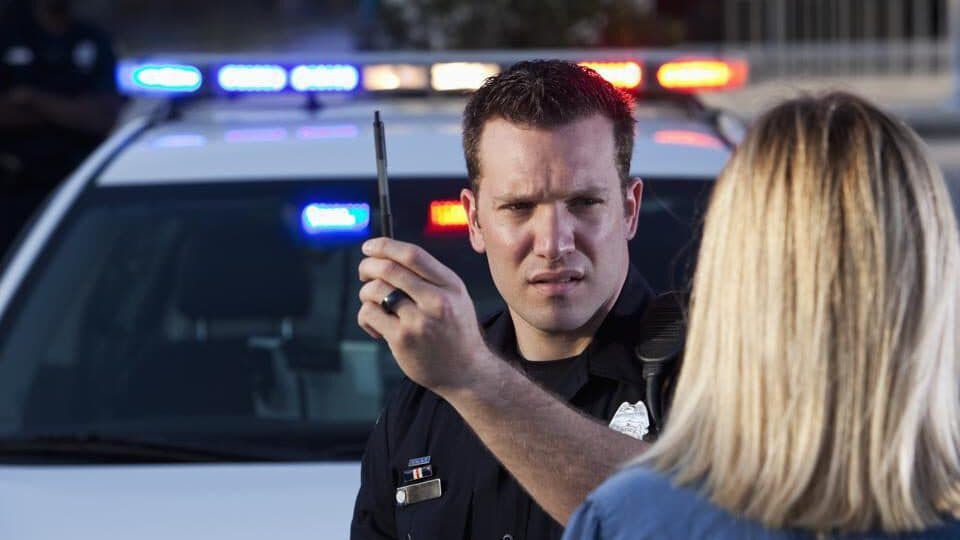
The HGN test in Maryland DUI cases is the “eye test”: the officer holds a stimulus (usually a pen or fingertip) in front of your eyes and asks you to follow it side-to-side. NHTSA trains officers to:
- Position the stimulus about 12–15 inches in front of the nose, slightly above eye level.
- Move it smoothly from center to the side and back, watching each eye for specific jerking (“nystagmus”).
- Estimate a 45-degree angle by moving the stimulus roughly as far to the side as it is from the nose (e.g., 12 inches forward, 12 inches to the side).
- Make at least 14 passes over ~82 seconds for a properly timed test.
HGN “Clues” and the Six-Point Scoring System
NHTSA identifies six HGN clues (maximum of three per eye):
Each eye jerks instead of tracking smoothly as the stimulus moves.
Eyes held far to the side keep bouncing after 4 seconds at the extreme corner.
Jerking begins before the eye reaches the estimated 45-degree point.
NHTSA’s own materials claim that, under perfect conditions, seeing 4 of 6 clues correlates with a BAC at or above the legal limit – but even in their studies the error rate was significant.
How Maryland Courts Limit HGN Evidence
Maryland appellate courts treat HGN as scientific evidence. The prosecution must show:
- The officer has specific training and experience with HGN.
- The test was administered in substantial compliance with NHTSA.
- The testimony is limited: HGN may show presence of alcohol, not a specific BAC number.
Practically, that means HGN should not be the star witness at trial. It’s one piece of the puzzle – and a piece that an experienced Maryland DUI lawyer can often shrink in front of a jury.
Attacking 45° and 18-Inch Rules in HGN
Why distance, timing, and angles can make the whole HGN test unreliable
From the defense side, HGN is fertile ground. On cross-examination, we compare the officer’s training and the body-cam video against NHTSA’s own instructions:
- Distance: Did the officer hold the stimulus at the correct distance (12–15 inches)? If they’re at 18 inches, their 45-degree estimate is off, and so is the “onset before 45°” clue.
- Timing: Did the passes actually last long enough? If the officer zips through the passes in under 60–70 seconds instead of ~82 seconds, there isn’t enough observation time.
- Head movement: Did the officer stabilize your head, or were you allowed to move? Head movement can artificially create or mask nystagmus.
- Lighting & distractions: Flashing emergency lights or moving traffic in the background can trigger optokinetic nystagmus even in sober people.
If the officer cannot clearly articulate – and the video doesn’t show – a test that stayed within NHTSA rules, a judge may limit how the State can use HGN evidence, and a jury can be persuaded to give it very little weight.
Walk-and-Turn Field Sobriety Test
The walk-and-turn field sobriety test is a divided-attention test: you must balance, follow instructions, and count steps at the same time. The officer should:
- Place you in a heel-to-toe stance with arms at your sides.
- Explain and demonstrate nine heel-to-toe steps down a straight line, a pivot, and nine back.
- Tell you to keep watching your feet, count out loud, and not stop until finished.
Eight NHTSA Walk-and-Turn “Clues”
Under NHTSA, officers look for up to eight clues:
Breaks heel-to-toe stance while listening to instructions.
Begins walking before being told to start.
Pauses to regain balance instead of continuous walking.
Gaps of more than ½ inch between heel and toe.
Foot moves entirely off the designated line.
Raises arms more than 6 inches from the body.
Spins or pivots incorrectly instead of taking small steps.
Takes more or fewer than nine steps in either direction.
How Walk-and-Turn “Clues” Get Misinterpreted
- Natural caution looks like “clues”: A sober person may slow down on gravel or a broken shoulder; officers score that as “stops while walking.”
- No real line: NHTSA expects a designated straight line. Many stops happen on dark shoulders with no line at all.
- Normal arm swing: Ordinary arm movement can look like “using arms for balance,” especially in a bulky coat.
- Uneven legs or injuries: A prior knee surgery or recent fall can explain stepping off the line or extra steps.
One-Leg Stand Field Sobriety Test
The one-leg stand field sobriety test is another divided-attention exercise. You’re told to:
- Stand with feet together, arms at your sides.
- Raise one foot about six inches off the ground, leg straight, toes pointed.
- Look at the raised foot and count “one thousand one, one thousand two …” until told to stop (about 30 seconds).
Four One-Leg Stand Clues
Officers are trained to look for four clues:
Side-to-side or back-and-forth movement while standing on one leg.
Raises arms more than 6 inches to maintain balance.
Hopping on the support foot to avoid falling.
Foot touches the ground before 30 seconds is up.
Who Shouldn’t Be Given a One-Leg Stand Test?
NHTSA acknowledges that people over 65, 50+ pounds overweight, or with back, leg, or inner-ear problems may have trouble even when sober. High-heel shoes (especially over two inches) are another red flag. These same factors apply under Maryland DWI field sobriety test practice.
Yet officers routinely ask people with a twisted or sprained ankle, a “boot” (Velcro walking cast), or chronic balance issues to perform the test anyway – and then call normal wobbling “evidence of impairment.”
Touch-Your-Nose / Finger-to-Nose Test in Maryland
Many Maryland officers add a touch-your-nose test to the lineup. This is not one of the standardized NHTSA tests, and it has not been scientifically validated like HGN, walk-and-turn, and one-leg stand.
Typically, you are asked to:
- Stand with feet together, arms extended or at your sides.
- Close your eyes or tilt your head slightly back.
- Touch the tip of your nose with the index finger of the left or right hand as directed.
Officers claim to look for:
- Missing the tip of the nose.
- Using the wrong hand.
- Stumbling or losing balance while standing with feet together.
Because NHTSA never standardized this test, a Maryland DWI field sobriety attorney can argue:
- The test lacks known error rates and isn’t “scientific” enough for expert-style conclusions.
- At most it shows generic coordination – which can be affected by fatigue, nerves, or old injuries.
- Improper instructions or confusing hand sequences make any “clues” meaningless.
How Lighting, Road Surface, Footwear & Injuries Skew Field Sobriety Tests
NHTSA’s own manuals admit that environmental conditions and personal factors can dramatically affect performance on Maryland standardized field sobriety tests:
- Tests should be conducted on a “reasonably dry, hard, level, non-slippery surface.”
- Wind, rain, cold, and darkness can impair balance even in sober drivers.
- Age, weight, inner-ear issues, and musculoskeletal problems limit reliability.
- Women in high heels should be allowed to remove them before balance tests.
Real-world examples of unfair testing conditions
- Gravel shoulder at night: No painted line, uneven rocks – yet the officer scores “steps off the line.”
- Cold roadside in winter: Shivering or stiff muscles make holding one leg up for 30 seconds much harder.
- Rain and slick pavement: A cautious slow walk becomes “stops while walking” and “improper turn.”
- High-heel shoes: A juror in sneakers may think you “should” have kept perfect balance; NHTSA says otherwise.
A seasoned Maryland DUI defense attorney brings these factors to life at trial – often using body-cam footage, weather data, and sometimes even on-site photos of the exact stretch of roadway where the test occurred.
Odor of Alcohol vs. Actual Impaired Driving in Maryland
Officers often write that they detected a “strong odor of alcohol” and then treat that as near-proof of impairment. In reality:
- Odor of alcohol only shows exposure, not impairment. A single drink, a spilled beer, or a passenger who’s been drinking can all produce odor.
- Maryland’s courts have said that odor can justify further investigation or a request for a chemical test, but odor alone does not prove you were unsafe to drive.
That’s why we ask: If your case involves only odor and no driving behavior like:
- Weaving or “ping-ponging” inside the lane;
- Crossing lane dividers or shoulder lines;
- Unexplained speed changes (faster, slower, faster);
- Running a light, rear-ending someone, or causing an accident;
then the State’s evidence of actual impairment is weak. We emphasize to judges and jurors that odor of alcohol by itself is not enough to prove DUI or DWI if there are no impaired-driving indicators and field tests are unreliable.
How Maryland Courts Treat Field Sobriety Tests
Maryland’s appellate decisions draw important lines about Maryland DWI field sobriety tests:
- HGN (eye test): scientific evidence, admissible only to show you have consumed alcohol, not to assign a specific BAC.
- Walk-and-Turn & One-Leg Stand: may be described by officers based on training and experience as circumstantial evidence of impairment.
- Non-standardized tests (alphabet, touch-your-nose, counting backwards): treated as general observations, not scientific tests.
- Video vs. report: where the report claims multiple “clues” but body-cam doesn’t show them, courts are increasingly skeptical about using field test results as the foundation for probable cause.
Case Law That Can Shift Admissibility
HGN & Scientific Limits
Maryland appellate courts have held that HGN is scientific and must be supported by proper training and administration. It is limited to showing alcohol consumption, not an exact BAC or a per-se DUI.
Body-Cam vs. Written Report
In more recent cases, courts have taken seriously the mismatch between what a report claims (e.g., “five of eight clues”) and what the video actually shows. A defense lawyer can leverage these gaps to argue suppression or at least diminished weight.
Expert Testimony & Daubert-Style Scrutiny
Because HGN is scientific, the officer’s expertise and methodology can be attacked under Maryland’s rules on expert testimony. If training is thin or the method deviates from NHTSA, HGN testimony can be excluded or sharply limited.
How to Challenge Maryland Standardized Field Sobriety Tests
A Maryland HGN, walk-and-turn, and one-leg stand lawyer doesn’t focus on whether you “passed” or “failed.” The question is whether the tests are reliable enough to matter at all.
1. Instruction Errors & Deviations from NHTSA
- Officer didn’t give the full, standardized instructions.
- No clear demonstration of how to walk, turn, or raise the foot.
- No confirmation that you understood the directions.
- Officer improvised or combined multiple instructions at once.
When instruction errors stack up, a defense attorney can argue that the test is no longer the NHTSA test at all – just a homemade exercise. The more the procedure departs from NHTSA, the stronger the argument to suppress the results or to convince a jury they’re worthless.
2. Mis-Scoring and “Clues” That Never Happened
Body-cam is the best friend of the defense. A seasoned DUI lawyer will:
- Compare each claimed “clue” in the report to the actual video.
- Slow the video frame-by-frame and document where you did keep your balance or walked heel-to-toe.
- Create demonstratives (screenshots, timelines) showing that the officer mis-counted steps or mis-characterized your movements.
When the written narrative doesn’t match the body-cam, a judge or jury can begin to question every aspect of the officer’s testimony – including their conclusion that you were impaired.
3. Medical Conditions, Injuries & Temporary Limitations
Field sobriety tests assume a healthy, athletic person. That’s not reality. Conditions that can mimic “clues” include:
- Twisted or sprained ankle; knee or hip injuries.
- Back problems, vertigo, or inner-ear issues.
- Neuropathy, neurological conditions, or medication side-effects.
- Use of a walking boot, brace, cane, or other assistive device.
Medical records, physical therapy notes, even photos of a brace or boot can be powerful evidence to show that “poor performance” proves nothing about alcohol.
4. Language & Comprehension Problems
If English isn’t your first language – or you have limited literacy, hearing issues, or cognitive challenges – field tests are inherently unfair without tailored instructions. That’s covered more deeply in the next section, but it’s also a core way to challenge admissibility.
Non-English Speakers, Language Barriers & Field Sobriety Tests
For drivers with limited English, field sobriety tests can be a trap. The officer might:
- Rattle off instructions too quickly.
- Use idioms (“heel-to-toe,” “small pivot steps”) that don’t translate well.
- Assume understanding because you nod or say “okay” under stress.
But if you never truly understood the directions, your performance says more about language than alcohol.
How a language disconnect can help your defense
- Due process & fairness: Courts require that important rights and instructions be reasonably conveyed. If language makes that impossible, a judge may discount or exclude the tests.
- Interpreter issues: If there was no interpreter or the interpreter was ad-hoc and untrained, that undermines the reliability of what you were told to do.
- Body-cam audio: We can often show long pauses, confused answers, and repeated questions – proof that the officer knew you were struggling to understand.
In close cases, a strong language-barrier record can lead to suppression of the tests or, at minimum, convince a jury that the State’s “clues” don’t mean what the officer thinks they mean.
Refusing Field Sobriety Tests & Breath Tests in Maryland
There are two separate decisions in most Maryland DUI investigations:
- Whether to perform field sobriety tests (HGN, walk-and-turn, one-leg stand, touch-your-nose).
- Whether to submit to an evidentiary breath or blood test after arrest.
Refusing Field Sobriety Tests
- Field tests in Maryland are voluntary. There is no automatic license penalty for refusing them.
- Officers may still arrest you based on driving behavior, odor, and other observations, but they lose one of their favorite tools for building probable cause.
- For someone with strong physical limitations or a language barrier, refusal can be the most rational choice.
Refusing the Breath or Blood Test (Implied Consent)
Maryland’s implied consent law says that if you refuse a properly requested breath or blood test after arrest:
- Your driver’s license can be suspended for about 9 months (270 days) for a first refusal.
- A second or later refusal can mean a 2-year suspension.
- You may qualify for the Ignition Interlock Program instead of a straight suspension.
When Refusal Might Make Strategic Sense
Every case is unique, and this page is not specific legal advice. But as a general concept:
- If you had zero drinks, a clean breath test can be powerfully exculpatory.
- If you had one or more drinks and can realistically tolerate a 9-month license suspension (for example, no daily commute, remote work, or alternative transportation), refusing the chemical test may prevent the State from ever having a hard BAC number.
- For someone with a boot, brace, or other mobility limitation, refusing roadside tests can be framed as a reasonable decision to avoid unsafe exercises.
A refusal does not guarantee a win in the criminal case – but removing the most damning piece of evidence (the BAC number) can significantly improve your odds, especially when field tests are also weak.
Interactive: Watch Field Sobriety Tests on Video
Seeing the tests in action helps juries – and clients – understand how subjective they really are. Here are some widely referenced demonstrations and explainers:
Standardized Field Sobriety Tests – Full Demonstration
A complete demonstration of the three main tests as used nationwide.
YouTube
Horizontal Gaze Nystagmus Explained
A deep dive into the HGN test, how officers are trained, and what they claim it shows.
YouTube
Walk-and-Turn – NHTSA-Style Demo
Demonstrates the walk-and-turn test under ideal training-video conditions – very different from a dark Maryland roadside shoulder.
YouTube
One-Leg Stand – Common “Clues”
Shows how officers score swaying, hopping, and using arms – and how easy it is to rack up “clues” even if you’re sober.
YouTube
FAQ: Maryland DUI Field Sobriety Tests
Are Maryland DUI field sobriety tests required?
No. Roadside field sobriety tests (HGN, walk-and-turn, one-leg stand, touch-your-nose) are voluntary. Refusing them is not a separate crime. However, the officer may still arrest you and may note your refusal in their report.
What are the “four acceptable parts” of the tests in Maryland?
On the street, officers often talk about four field sobriety exercises:
- Horizontal Gaze Nystagmus (HGN)
- Walk-and-Turn
- One-Leg Stand
- Touch-your-nose / similar divided-attention task
NHTSA has only standardized the first three. Maryland courts treat the three NHTSA tests as potentially admissible if properly administered; the fourth is a non-standard exercise that is easier to challenge.
Can field sobriety tests be completely suppressed?
Sometimes. If the officer’s training is inadequate, the tests were badly mangled, language or disability issues made them inherently unfair, or the State can’t lay a proper foundation, a judge may keep some or all test evidence out. More often, the goal is to limit how the State can use the tests and convince the jury they don’t prove much.
How can a lawyer use body-cam to beat field sobriety tests?
We line up the officer’s report with the video – step by step, clue by clue. If the report says you “started too soon,” but the video shows you waiting for the command, that’s a credibility hit. If the report claims you missed heel-to-toe “multiple times” but the camera angle doesn’t show that, we can argue the officer is exaggerating or mistaken.
Can a refusal be used against me?
Yes. Prosecutors often argue that refusing a breath test shows a “guilty conscience.” The defense answer is to show rational reasons for refusal: serious injuries, mistrust of a machine, concern about language comprehension, or the ability to tolerate a license suspension rather than give the State a high BAC number.
Do I still need a lawyer if my test “looked bad”?
Absolutely. Many people who “looked terrible” on the officer’s checklist turn out, on careful review, to have understandable balance issues, poor conditions, or instruction problems. The sooner a defense lawyer reviews your body-cam and DR-15 paperwork, the better your chances of saving your license and your record.
Talk to a Maryland DUI & DWI Defense Attorney
If you’re facing Maryland DUI field sobriety tests evidence, Hadden & Moschkin can help you challenge every angle – from HGN angles and distance, to walk-and-turn step counts, to one-leg stand clues under unfair conditions.
Call or text us 24/7 at (240)992-4733, or use the secure form below.
Explore more information about DUI and DWI representation in Maryland by reviewing my handbook page: https://www.https://duidefensemd.com/dui-dwi-handbook/